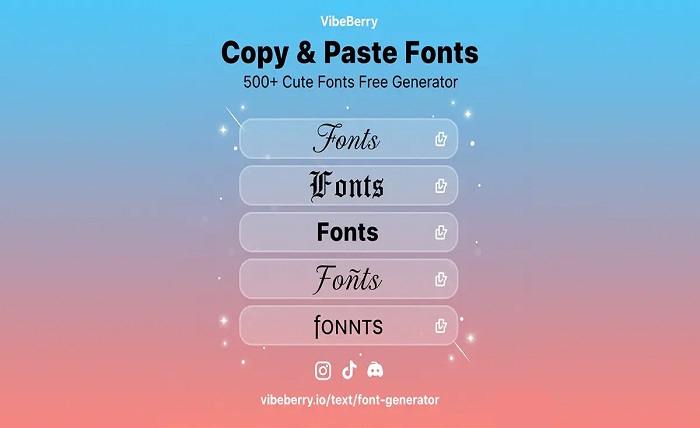
When people talk about wanting to “copy and paste fonts,” they’re usually not referring to font files like .ttf or .otf. Instead, they’re looking for a way to generate stylized text they can paste directly into social media bios, posts, or usernames . The output from these tools isn’t actually a font in the traditional sense—it’s standard Unicode characters that happen to look like bold, italic, cursive, or gothic versions of the regular alphabet . This is why you can copy and paste fonts without installing anything on your device.
The Technology Behind Copy and Paste Fonts
The magic behind being able to copy and paste fonts lies in Unicode. Every letter, number, and symbol has a unique code point in the Unicode standard. Some of these code points are mathematical alphanumeric symbols that look like styled versions of regular letters—bold, script, fraktur (gothic), and more . When you use a font generator to copy and paste fonts, the tool maps your regular text to these Unicode equivalents. The platform you paste into—whether Instagram, Twitter, or Discord—displays these characters as text because they are text. Nothing gets installed. No files are transferred. You simply copy and paste fonts as Unicode strings .
The Most Popular Styles You Can Copy and Paste
When you decide to copy and paste fonts for your profile or post, you’ll typically encounter these popular styles :
-
Bold: 𝗕𝗼𝗹𝗱 𝗳𝗼𝗻𝘁𝘀 𝗹𝗼𝗼𝗸 𝗵𝗲𝗮𝘃𝗶𝗲𝗿 𝗮𝗻𝗱 𝗺𝗼𝗿𝗲 𝗱𝗿𝗶𝘃𝗲𝗻.
-
Italic: 𝘐𝘵𝘢𝘭𝘪𝘤 𝘤𝘰𝘱𝘺 𝘢𝘯𝘥 𝘱𝘢𝘴𝘵𝘦 𝘧𝘰𝘯𝘵𝘴 𝘢𝘳𝘦 𝘴𝘭𝘢𝘯𝘵𝘦𝘥 𝘢𝘯𝘥 𝘴𝘰𝘧𝘵𝘦𝘳.
-
Cursive/Script: 𝓒𝓾𝓻𝓼𝓲𝓿𝓮 𝓬𝓸𝓹𝔂 𝓪𝓷𝓭 𝓹𝓪𝓼𝓽𝓮 𝓯𝓸𝓷𝓽𝓼 𝓵𝓸𝓸𝓴 𝓹𝓮𝓻𝓼𝓸𝓷𝓪𝓵 𝓪𝓷𝓭 𝓮𝓵𝓮𝓰𝓪𝓷𝓽.
-
Gothic/Blackletter: 𝔊𝔬𝔱𝔥𝔦𝔠 𝔠𝔬𝔭𝔶 𝔞𝔫𝔡 𝔭𝔞𝔰𝔱𝔢 𝔣𝔬𝔫𝔱𝔰 𝔥𝔞𝔳𝔢 𝔞 𝔪𝔢𝔡𝔦𝔢𝔳𝔞𝔩, 𝔥𝔢𝔞𝔳𝔶 𝔳𝔦𝔟𝔢.
-
Bubble: ⓑⓤⓑⓑⓛⓔ ⓣⓔⓧⓣ ⓘⓢ ⓕⓤⓝ ⓐⓝⓓ ⓒⓘⓡⓒⓤⓛⓐⓡ.
-
Small Caps: sᴍᴀʟʟ ᴄᴀᴘs ᴀʀᴇ ᴛʜᴇ ᴍɪɴɪᴍᴀʟɪsᴛ ᴏᴘᴛɪᴏɴ.
-
Upside Down: ʇxǝʇ uʍop ǝpᵢsdn ᵢs ᵤₙᵢqᵤₑ.
Where to Use Copy and Paste Fonts for Maximum Impact
Certain platforms have become hotspots for people who want to copy and paste fonts to stand out :
-
Instagram Bios: Your bio is a three-second read. A bold username or a cursive tagline creates visual hierarchy and signals intentionality .
-
Twitter/X: Since there’s no native text formatting on Twitter, using copy and paste fonts immediately makes a tweet or bio stand out in a feed of default text .
-
TikTok: Bios are often short and overlooked. Styled text shows you care about your profile, not just your videos .
-
YouTube Descriptions: Creators use copy and paste fonts as section headers to break up walls of text, making information easier to find .
-
Discord: In communities with hundreds of members, a gothic or bold username creates distinction at a glance .
-
WhatsApp and Telegram: When you need a time or address to land in a busy group chat, copy and paste fonts create enough contrast to pull the eye immediately .
Font Generators vs. Installing Font Files
It’s important to understand the distinction between two completely different activities that both involve fonts. When you use a website to generate Unicode text, you’re learning how to copy and paste fonts as styled text. However, there’s also the literal process of copying and pasting font files to install them on your computer . If you want to install a new typeface on your Windows system, you navigate to C:\Windows\Fonts, right-click the font file, select Copy, and then paste it into that folder . Or, you can simply right-click the file and select Install . Many people ask how to copy and paste fonts in this file-transfer sense, but for social media styling, you’ll want Unicode generator tools like LingoJam, FontSpace, or CoolSymbol .
Common Mistakes When You Copy and Paste Fonts
While it’s easy to copy and paste fonts, there are some pitfalls to avoid :
-
Overloading your bio with too many styles. Using four different styles in one bio forces the eye to recalibrate constantly. One main style and one supporting style are plenty.
-
Choosing a style that doesn’t match your content. Gothic text on a financial planner’s LinkedIn or bubble text on a crisis counseling service sends the wrong message before anyone reads the words.
-
Not testing on mobile. Always check how your styled text renders on a phone before posting publicly.
-
Using obscure generator sites that embed hidden characters. Some tools insert invisible Unicode characters that cause copy-paste errors or broken links. Stick with well-known generators .
Copy and Paste Fonts and SEO
If you copy and paste fonts on your website, there’s a major SEO consideration. Search engines read text based on Unicode values. A regular “H” and a bold Unicode “H” are different code points . This inconsistency creates risk in headings and page titles where keyword relevance matters. The best practice is simple: use copy and paste fonts freely on social media bios, captions, and usernames. But for website page titles, meta descriptions, headers, and body copy, stick to regular text. Use CSS if you want visual styling on a website—that’s what CSS exists for .
Troubleshooting Common Issues
If you copy and paste fonts and see boxes or question marks instead of styled characters, the device or app you’re pasting into doesn’t support those specific Unicode characters . Try a different style and reduce the use of rare symbols. If you’re dealing with font formatting changes when pasting text between applications—like Word and Outlook—that’s a different issue caused by how each program handles clipboard formatting, not Unicode text . In that scenario, you’d want to adjust your paste settings to “Keep Source Formatting” or “Merge Formatting” in the program’s options .
Conclusion
Being able to copy and paste fonts is a quick, free way to add personality and visual hierarchy to your social media presence. These generated “fonts” aren’t actual font files—they’re Unicode characters that look styled, and they work because platforms display them as standard text. While you should avoid using copy and paste fonts for critical SEO content on your website, they’re perfect for Instagram bios, Twitter posts, Discord usernames, and any social platform where you want to stand out. Just remember to test on mobile, keep it simple, and stick with reputable generators for the best results.
FAQs
1. Are copy and paste font generators safe to use?
Generally yes, when they output standard Unicode without hidden characters. Avoid pasting unknown styled text into sensitive systems, and prefer tools that disclose their clipboard behavior .
2. Will using fancy text hurt my SEO?
It can, if you rely on styled characters for core keywords. Search engines treat those as different code points. Keep your primary keywords and headings in normal Latin text and treat styled text as decorative .
3. Why does my pasted text look different on another phone or app?
Rendering depends on device fonts and app environments. The same Unicode can appear slightly different—or fail to render—on certain systems. Always test on the platforms that matter to you .
4. Do these fonts work on Instagram, TikTok, Discord, and LinkedIn?
In most cases, yes—Unicode text pastes and displays. But moderation policies, font coverage, and accessibility behavior vary. Test before publishing, especially for usernames and headings .
5. What’s the difference between copying a Unicode font and installing a font file?
Copying a Unicode font means generating styled text from a generator and pasting it into a social platform. Installing a font file means copying a .ttf or .otf file into your system’s Fonts folder to use that typeface in design software or documents .